
What to ask an seo agency before you sign.

We have sat on the client's side of this conversation more than once, next to somebody about to sign for work they cannot evaluate. The agency is fluent, the deck is polished, and the questions that would have told them what they were buying tend to occur months later.
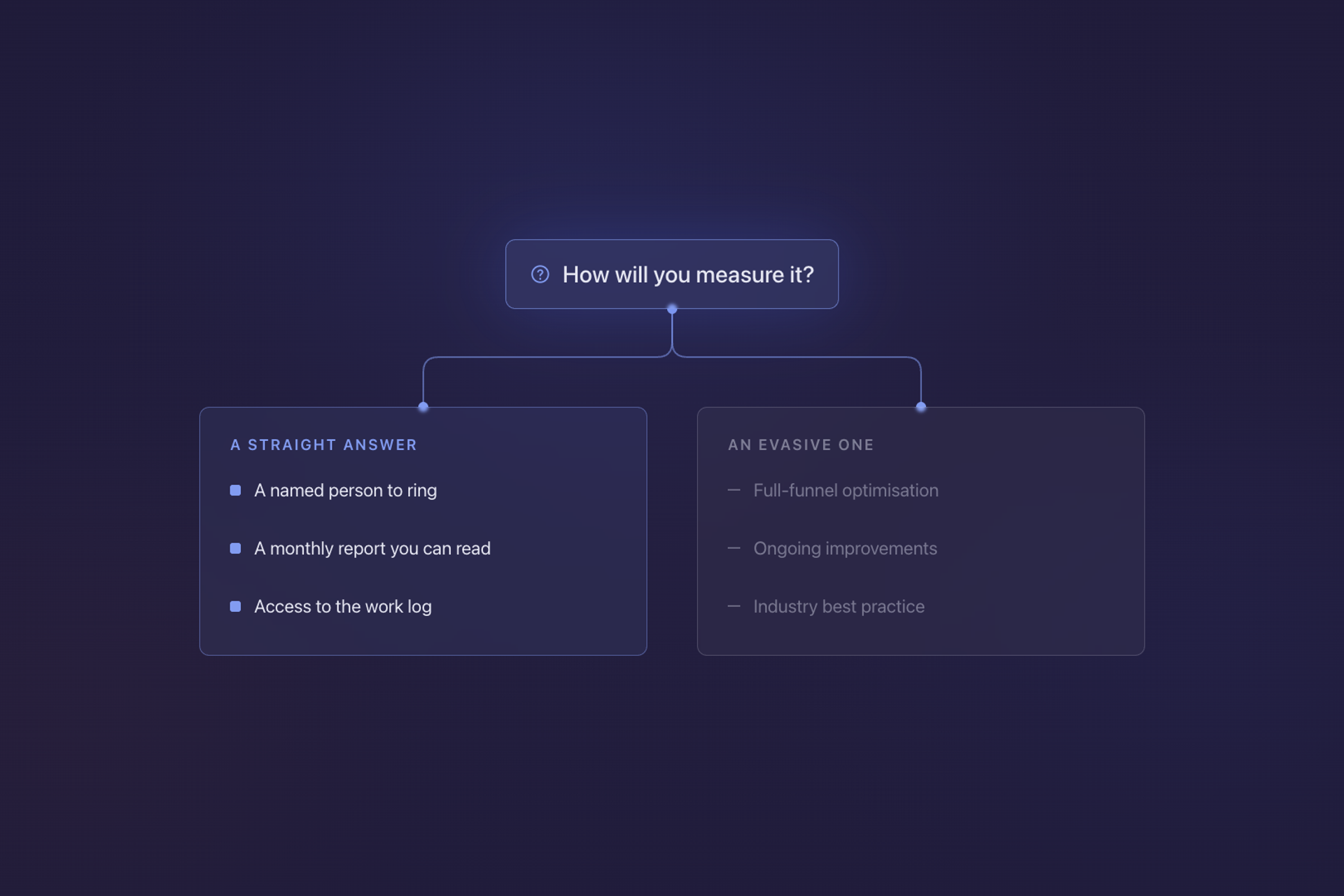
Search is unusually hard to buy. The work is mostly invisible, the results arrive slowly, and the distance between a good agency and a bad one is almost impossible to see from a proposal. Both send a monthly report and both use the same vocabulary. What follows are the questions we have watched separate them, and what a straight answer to each sounds like.
The questions
What will you actually do in the first three months? A good agency answers with activities and rough proportions: a technical audit, then fixing what it finds, then a content plan built around specific terms. A weak one answers with outcomes and adjectives. If you cannot picture somebody at a desk doing the work described, you have not been told what you are buying.
Which terms are you targeting, and why those? The reasoning matters more than the list. You want to hear search volume weighed against how hard the term is and how likely somebody typing it is to buy from you. An agency chasing the biggest term in your sector is either inexperienced or optimising for a report. The terms that make money are often unglamorous and specific, and a good agency will tell you that before you have paid them anything.
How much of this depends on changes to my site, and who makes them? This is where these projects quietly fail. A large share of the early gains are usually technical, and if the agency cannot make the change and your developer is not booked to, the recommendation sits in a document for a year. Ask who is doing it, and get the answer written into the contract.
What happens if I stop after six months? The honest answer is that content and technical work you own stay yours and keep earning, while anything depending on continued activity decays. What you are listening for is whether they distinguish the two. An agency telling you everything collapses the moment you stop is either building on rented ground or telling you what it needs you to believe.
What will you report, and how will I know it was your doing? Rankings and traffic are the easy part. The question is attribution, and the credible answer is a careful one: they will show what they changed, when, and what happened afterwards, while being straight that search is affected by things nobody controls. Confidence about attribution is a warning sign rather than a reassurance, because search results are not a laboratory.
Answers that should end the meeting
The clearest is a guarantee of first-place rankings. Nobody controls the ranking, and an agency promising a position is either lying or planning to rank you for a term nobody searches for, which it can do trivially and report as a win.
The clearest is a guarantee of first-place rankings. Nobody controls the ranking, and an agency promising a position is either lying or planning to rank you for a term nobody searches for, which it can do trivially and report as a win.
Another is a claimed relationship with the search engine. There is none, and no agency has a contact who can move you up.
Then there is a refusal to name the techniques. Some work is genuinely distinctive in its execution, but the categories are not secret, and "our methodology" as an answer to what you are buying is not an answer. The usual reason to hide a technique is that it carries a risk you would not accept if it were explained.
The same goes for buying links in volume, which works until it does not, while the recovery takes longer than the time it bought you.
Finally there is pressure on the timing, when search has no deadline. An offer expiring on Friday tells you about the agency's cashflow, not your opportunity.
One thing to do before any of it
Spend an hour searching for what you sell the way a customer would, in the words a customer says on the phone rather than the ones you use internally. It tells you whether the space is crowded or empty, whether directories dominate the results and would have to be bought into, and occasionally that nobody is searching for what you do at all, in which case the money belongs elsewhere. An agency worth hiring will tell you that, though not many get asked.
Then look at your own site, because whatever you spend on search runs on it. If pages load slowly, if the structure buries everything three clicks deep, if the markup gives a search engine nothing to read, a good agency spends its first months asking your developer for changes and the next ones waiting. That part is ours. We build sites, and the groundwork search needs is the same that makes a site worth visiting: fast pages, a sensible structure, clean markup, and content you can edit without raising a ticket. Get that right and whatever you spend afterwards goes on winning ground rather than repairs.
Azeem Hadi

Got a project in mind?
Or just want to talk through an idea? We are always happy to chat, no strings attached.
Thirty minutes, direct with the founder. No pitch deck.