
Defining an effective problem statement.

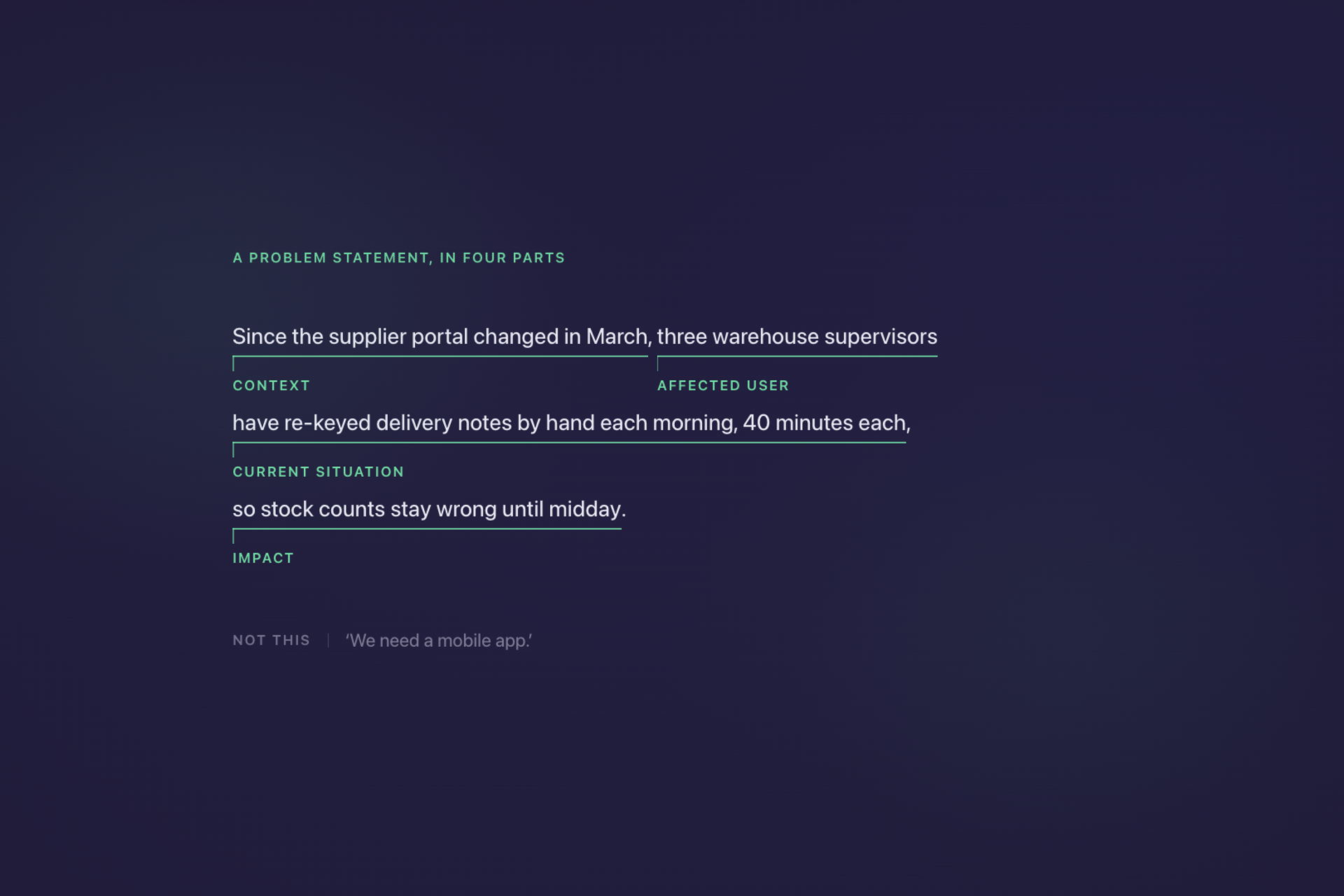
The difference between a project that delivers value and one that simply ships on time usually comes down to a question asked at the start: what problem are we actually solving?
Plenty of projects skip it, or bury it in a document nobody reads. Writing a problem statement feels like bureaucracy when you have a budget, a deadline and a general sense of the work, and it seems to spell out what everyone already knows. The trouble is that what everyone knows differs from person to person: the founder, the developer and the end user each carry a different goal. Those gaps compound quietly until someone says mid-build that they thought you were building something else, and the cost lands in rework, in scope changes, and in products that function but miss the point.
What a good one looks like
Compare two versions. The first: "We need a mobile app." The second: "Our technicians spend 40 minutes per job logging service data onto three disparate systems. This delays invoicing, increases administrative errors, and frustrates technicians who feel their time goes on busywork instead of skilled work."
The first is a solution wearing a problem's clothes. The second gives you something to work with and leaves the fix open: a new workflow, a web system, something else entirely. A good statement constrains the solution space without deciding it.
Four things do the work. Name the affected user specifically, because "small business owners managing their first hire" beats "users". Describe the current situation as it is, since "they don't have our software" is circular. State the impact, quantified where you can, though lost confidence counts alongside lost revenue. And give the context: a daily problem differs from a quarterly one, and one hitting your best customers from one hitting a handful.
Where they go wrong
The most common failure is solutioning in disguise. "The problem is we don't have automated email sequences" is an assumption about the answer. The real problem might be that leads go cold because follow-up depends on manual effort that never happens.
Then there is vagueness that sounds specific. "Users find the process confusing" feels concrete but isn't. Which users, which process? Vague statements produce vague work.
Stakeholders also describe symptoms. "Customers keep asking for feature X" might mean X is needed, or that they are trying to fix a different problem and assume X is the answer. And a statement conflating several problems can't be addressed coherently, so separate them and prioritise.
Three further failures come from motive. The politically convenient problem reflects what is acceptable to discuss, not what is happening, so the project addresses a fiction while the real dysfunction goes unnamed. The retrospectively invented problem is written after the answer has been chosen, and its specificity gives it away: only one product could address it. The problem nobody actually has is technically real, but not painful enough for anyone to pay to fix.
Start with evidence. Interview the people living with the problem, watch how they work, and read the support tickets and complaints.
Writing one, then using it
Start with evidence. Interview the people living with the problem, watch how they work, and read the support tickets and complaints. Then pressure-test the draft:
- Could someone new to the project understand what we are solving?
- Does it point at one particular answer, or stay open?
- Can we validate that this problem exists?
- Will we know whether we have fixed it?
Share it with stakeholders and the people affected. If they don't recognise their own reality in it, you have learned something useful.
Then keep it in play. When a feature gets proposed, ask whether it addresses the stated problem. When scope is debated, use it to sort essential from nice-to-have. It can change: sometimes you learn mid-project that the problem has moved or that you had it wrong, so update it and realign rather than drifting.
The time it saves
Defining the problem isn't glamorous, but it decides whether everything after it lands. Small businesses and resource-constrained teams feel pressure to skip it and figure things out as they go. Sometimes speed is the priority, but the irony is that careful definition usually makes the project quicker: less time building the wrong thing, fewer arguments about scope, and no late discovery that nobody agreed on the goal.
A clear problem statement won't solve everything, but it tells you whether you are solving the right thing, and that is where every project worth doing begins.
If you are about to start something, write it before the brief. One paragraph naming who is affected, what happens now, and what it costs. Show it to the people living with the problem and see whether they recognise themselves.
That is the first thing we do on any project, before scoping and before a quote. The first meeting is the cheapest place to find out the project should be a different one.
Azeem Hadi
Got a project in mind?
Or just want to talk through an idea? We are always happy to chat, no strings attached.
Thirty minutes, direct with the founder. No pitch deck.